Moving a petrol station from paper registers to software: a practical checklist
Where money and fuel go missing in a paper-based petrol station, a step-by-step checklist for moving to software, and how PetroOS is being built to make daily reconciliation simple.
Many petrol stations still run on registers: a book for nozzle readings, a book for tank dips, a diary for credit customers and a calculator at the end of every shift. It works, until the owner asks a simple question such as how much diesel did we actually lose last month? and nobody can answer it without a weekend of adding up pages.
Getting the numbers right matters to customers and regulators too. When the Oil and Gas Regulatory Authority inspected 220 petrol pumps in 2018, it found 59 violating standards, mainly by dispensing less fuel than customers paid for.[4] Accurate daily records protect an honest station as much as they expose problems.
At Text Tech Solutions we are building PetroOS, a petrol station management system designed around exactly these daily checks. The checklist below is what we recommend to every station owner, and at the end we explain how PetroOS is being built to make each step easier.
This article is for owners and managers who are thinking about moving to software. It explains where problems usually hide in a paper system, how fuel regulators and safety bodies recommend reconciling stock, and gives a practical checklist for making the switch without disrupting daily sales.
The one calculation that matters most
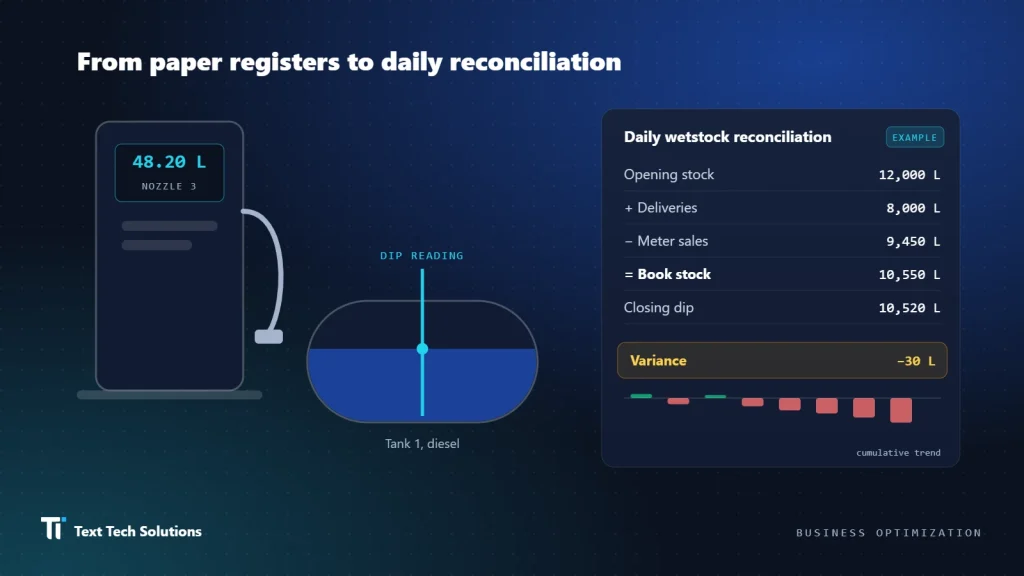
Fuel safety and environmental guidance around the world centres on the same daily calculation, usually called wetstock reconciliation.[1][2] For each tank, every day:
- Book stock = opening stock + deliveries received − litres sold through the meters
- Variance = closing dip − book stock
A small variance every day is normal, because of temperature changes and measurement limits. What matters is the trend. Ireland’s Health and Safety Authority advises owners to review losses and gains every day and to keep cumulative figures, because a slow leak that is invisible in any single day shows up clearly over weeks.[1] In the United States, operators who rely on inventory control must record measurements every operating day and reconcile at least every 30 days, investigating when losses go beyond a set limit.[3]
Where paper systems leak
Paper registers are not the problem on their own. The problem is that each register is checked separately, often days later, so small mismatches never meet each other. These are the places we look first:
- Shift handover. Opening and closing meter readings are written by hand. One wrong digit changes the litres sold for the whole shift, and the cash short or excess is then blamed on the wrong person.
- Meter sales against tank stock. When the reconciliation above is done monthly instead of daily, a leak, a calibration problem or theft can run for weeks.
- Deliveries. Guidance recommends recording the quantity on the delivery ticket, not the quantity you expected, and taking dips before and after unloading once the fuel has settled for a few minutes.[1] On paper, these readings often end up in different books, so short deliveries are hard to prove later.
- Credit customers. Fleet and regular customers who pay later are tracked in a diary. Balances drift, slips go missing and month-end statements turn into arguments.
- Cash, card and digital payments. When payment methods are not separated per shift, a card settlement that arrives late looks like a cash shortage.
What good software should give you
Before comparing products, decide what you need to see every day. For most stations it is a short list:
- A shift report that shows litres sold per nozzle, expected cash and actual cash, side by side.
- A daily wetstock view per tank: opening stock, deliveries, meter sales, book stock, closing dip, variance and the running cumulative variance.
- Credit customer accounts with every slip recorded and a balance that is always current.
- Simple entry screens that a pump attendant or shift manager can use without long training sessions.
- Reliable records when the internet is down. Many stations have weak connections, so software that keeps working offline and syncs later is far safer than a system that stops at the counter.
A checklist for the switch
1. Clean up your starting numbers
Pick a start date, ideally the first day of a month. Take physical dips of every tank, record every nozzle totalizer and write down every credit customer balance. These become your opening figures. If the opening numbers are wrong, every report after them will be wrong too.
2. Set up the station exactly as it is
Enter every tank, its product and capacity, every dispenser and nozzle and which tank it draws from, and your current prices. Name things the way your staff already talk about them, so a shift manager recognizes Nozzle 3 immediately.
3. Run paper and software together for two to four weeks
Keep the registers going while staff enter the same readings into the software. Compare the two every day. Differences in this period are useful: they show you where the old process was unclear, and they build trust that the new numbers are right.
4. Decide who enters what, and when
Write down a short routine: who records readings at shift change, who records dips and deliveries, who approves a credit sale. For 24-hour stations, fix one closing time for the daily figures. Software only helps when the same person does the same step at the same time every day.
5. Review one report every day
Owners do not need twenty dashboards. Pick the daily variance per tank and the cash difference per shift, and look at them every morning. Investigate anything unusual the same day, while people still remember what happened.
6. Keep up the physical checks
Software does not replace good housekeeping. Safety guidance recommends checking tanks for water regularly, ideally daily and at least weekly, and having pump meters checked for accuracy at least once a year.[1]
7. Retire the registers
Once the software and the registers agree for a few weeks in a row, stop the duplicate paperwork. Keep the old books safely for your records, but make the software the single place where the day is closed.
Common mistakes to avoid
- Starting in the middle of a month with estimated opening stock.
- Recording the expected delivery quantity instead of the ticketed one.
- Letting several people share one login, so nobody knows who entered a reading.
- Looking only at daily variance and ignoring the cumulative trend.
- Skipping the parallel period because the first week looked fine.
- Choosing software that only works with a stable internet connection.
Where to start
If your station still closes the day on paper, start with two comparisons every single day: book stock against the closing dip for each tank, and expected cash against actual cash for each shift. Even before you choose software, doing these two checks daily will show you where your losses are.
How PetroOS supports your station
PetroOS is our petrol station operations software, built for the realities of local fuel stations: owners who want clear numbers every morning, staff who need simple screens, and internet connections that cannot always be trusted. Its purpose is to bring the separate registers, spreadsheets and phone messages described in this article into one system.
- One place for daily operations. Sales, stock and shift records together, so the two daily comparisons in this article come from one source instead of three different books.
- Keeps working offline. Records continue to be captured when the connection drops, with a cloud backup once the station is back online, so a weak signal never stops the counter.
- Runs on the devices you already have. Designed for Windows, Mac and Android, so owners can check the day’s numbers from the office computer or a phone.
- Clear records for owners and managers. Numbers that are easy to check and hard to dispute, so a shortage is found the same day rather than at month end.
PetroOS is currently in development, and we are shaping it together with station owners. That is an advantage for early users: the way your station works today can directly influence how the software works tomorrow.
PetroOS early access
Run a fuel station? Help shape the software built for it.
Tell us how your station records sales, stock and shifts today. We will show you where PetroOS fits and let you know as soon as early access opens.
Prefer a form? Send us your station’s details and choose “Ask about a product”.
References
- Health and Safety Authority, Ireland (2013). Wetstock Reconciliation at Fuel Storage Facilities: An Operator’s Guide. hsa.ie (PDF)
- US Environmental Protection Agency. Doing Inventory Control Right: For Underground Storage Tanks. archive.epa.gov (PDF)
- Texas Commission on Environmental Quality. Inventory Control for Petroleum Storage Tanks. tceq.texas.gov
- Associated Press of Pakistan (2018). OGRA inspects 220 petrol pumps, 59 detected compromising standards. app.com.pk